
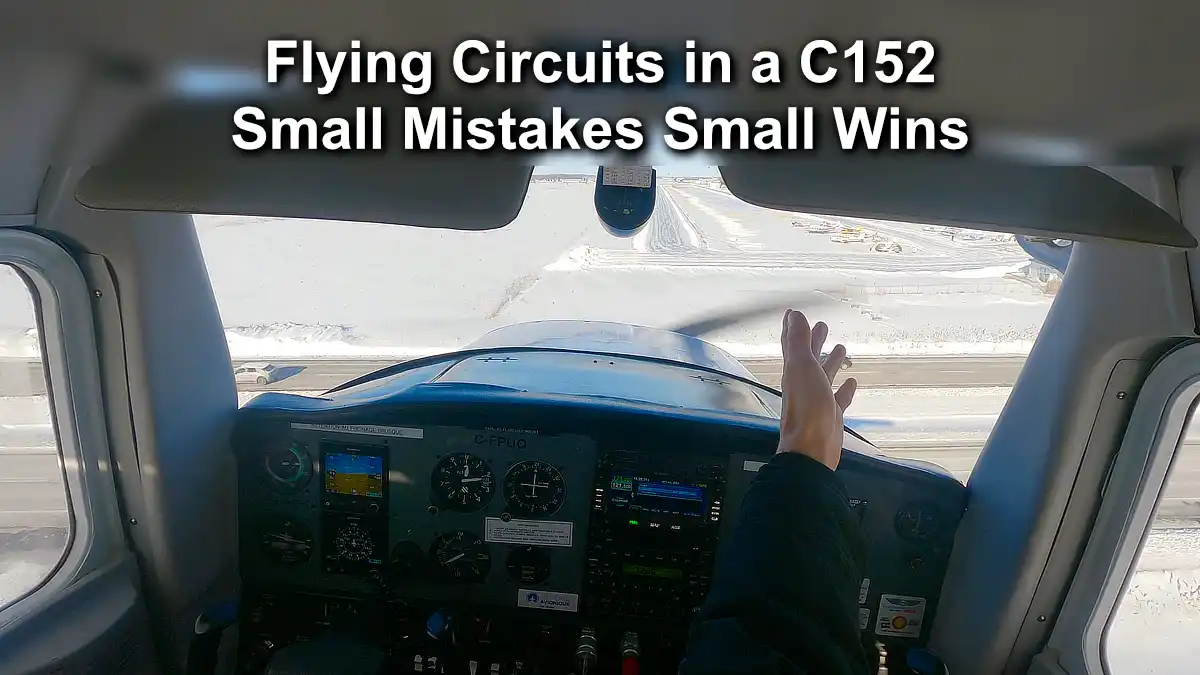
Flying circuits in a Cessna 152 during one of my early winter PPL lessons at St-Hyacinthe (CSU3). This is not a tutorial, but a short cockpit note from repeated circuits: real intercom audio, instructor corrections, a missed touch-and-go, a demonstration, and a landing that finally came together.
Video transcript
Transcript — Flying Circuits in a Cessna 152: Small Mistakes, Small Wins
Winter circuit training at St-Hyacinthe aerodrome (CSU3). Two voices: the flight
instructor and the student pilot. Lines marked (radio) are transmissions on
the aerodrome traffic frequency.
[0:00] Takeoff
Instructor: Because the runway is a little icy, we use brakes very lightly when we land.
Student: Okay. Okay, go?
Instructor: Yep, when you’re ready. Excellent. Perfect. Airspeed alive, we’re in the green.
Student: 55?
Instructor: 55, rotate. Yep. Perfect.
[0:38] Initial climb and first circuit
Student: Do I need to call? I forget.
Instructor: Yeah, you could call — your initial climb, runway 02, and we’re staying in the circuit.
(radio) Saint-Hyacinthe traffic, Foxtrot Papa Uniform Quebec, initial climb for the circuit, runway 02.
(radio) Saint-Hyacinthe traffic, FPUQ — end of downwind, runway 02, for a touch and go, number two.
Student: So we need to… decrease speed?
Instructor: Yeah, decrease speed, exactly. And don’t forget the carb heat as well.
Instructor: And you see the other traffic?
Student: Yes, I see it on the final.
Instructor: Perfect, exactly.
Student: Do we need to… uh… wait, or?
Instructor: As soon as he’s gone, or he’s below your wing, you can turn. So you can start turning if you want — he’s past your wing, so that’s fine.
[1:32] Setting up the touch-and-go
Student: So we’ll do a touch and go?
Instructor: Yeah, we’ll try to. Depending on where we land, I’ll let you know. On the runway, as we touch, it should be a touch and go. We’re at good speed, good altitude. Over the 116 route here you should be about 200 feet, so that’s good. You can start reducing RPM slowly. Yep, start reducing RPM.
[2:12] Missed approach
Instructor: I’ve got controls. We’re just a little far, so… overshoot. Full power. Just because of the ice, we want to land… I’ll show you the next final, and I’ll do it so you can see how I do it.
[2:29] Instructor’s demonstration
Student: Okay, your controls.
Instructor: Perfect. So airspeed is good, and I’ll start reducing to 1500 RPM, not more at this point. I’ll start looking very far ahead, and slowly reduce RPM. I’ll set a little cruising attitude, and I’ll start pulling up as I start reducing power. I pull up — there you go. Flaps up. Full power. Carb heat. 55, I can rotate.
Instructor: So you saw — I reduced power as I was pulling the controls, just for the landing there.
[3:16] Student takes over
Student: Okay, I’ll try.
Instructor: Yeah, no problem. It’s practice — you have to practice it. Good. Keep going like that. You can start reducing power very slowly. Airspeed is good. Continue reducing RPM, still going down. There you go — that was good. And there you go, full power. Very good landing.
Instructor: So you see — you slowly took off the power, and you slowly pulled the control up.
Student: Yeah. I just need to practice the power.
Instructor: No problem. It’s practice, as you said — and you’ll learn. That’s good.
[4:08] Next circuit
Instructor: Perfect, 1100 feet, you could stabilize. Oh yeah, the carb heat is still on — there you go. Perfect. Do you see the traffic in front of us?
Student: Yes.
Instructor: Perfect. Don’t hesitate — you can put 2200 RPM here so you don’t keep climbing. Yep, slowly reduce power. Pull up on the column. Flaps up. Full power, and carb heat afterwards. Carb heat off. 55, rotate. Rotate. You could start reducing power. Reduce, reduce, reduce. Start pulling. Very good. Pull, pull, pull — there you go. Good, very good. Flaps up, full power, we’re gone.
[5:15] Continuing circuits
Instructor: Perfect. Excellent. Flaps up. Full power. Carb heat off. Full power. 55. Perfect. Very good.
[5:47] Taxi back
Student: You said no need to use a lot of brakes.
Instructor: Yeah.
This flight was part of my early PPL training at the Académie de l’aviation St-Hyacinthe with instructor Steven de l’Étoile.
I also have a separate Cessna 152 bounced landing and go-around note from the same aerodrome in similar winter conditions.
In Canadian terminology, this kind of repeated training pattern around an aerodrome is an aerodrome traffic circuit.
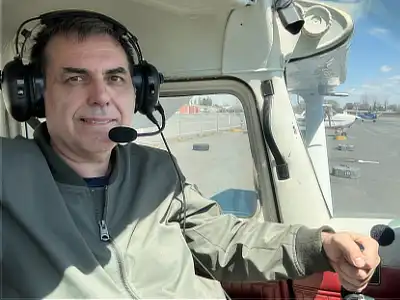
Alexander Deyneko is a student pilot in the final stages of completing his Private Pilot Licence. Member of the Canadian Owners and Pilots Association (COPA). Has flown the Cessna 152 and 172 and the Schleicher ASK-21 glider, with familiarization flights in the historic Boeing Stearman PT-17 and Harvard Mk. IV. A former paragliding pilot-instructor certified by the Russian United Federation of Ultralight Aviation, where he also founded and ran a private paragliding club. Documentary filmmaker covering aviation subjects, with experience in aerial and 360° video production.
More about the author…