
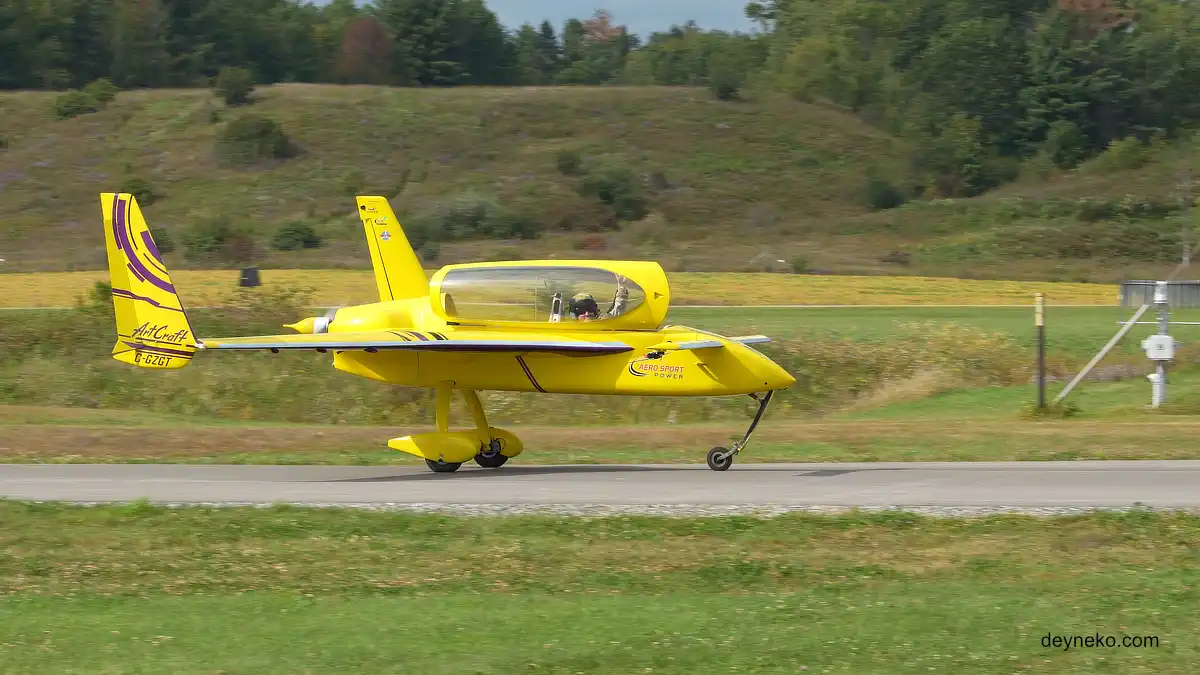
Kyle Fowler on his Rutan Long-EZ: cockpit look, IO-360 engine cooling issues, nose gear, speed, range, and why it does not stall.
Transcript — Rutan Long-EZ: Kyle Fowler Interview and Cockpit Look
Airshow pilot Kyle Fowler talks about his Rutan Long-EZ: why this canard aircraft does not stall like a conventional airplane, why the IO-360 runs hot, why the aircraft parks on its nose, and what it weighs, how fast it goes and how far it flies.
Speakers: Kyle Fowler, the airshow announcer, and visitors near the aircraft. Filmed at Aero Gatineau-Ottawa 2023. Questions from visitors near the aircraft are labelled as Visitor. Visual descriptions are marked in square brackets.
00:00 — Who Kyle Fowler is
[On screen: Kyle Fowler smiles beside his yellow Rutan Long-EZ. The canopy, tail and fuselage are visible. Other aircraft are parked behind him at the airshow.]
Kyle Fowler:
It’s a lot of fun. I really do like it.
[On screen: the yellow Long-EZ flies an airshow pass with a smoke trail, climbing against a cloudy sky.]
Announcer:
Kyle Fowler is from Central Alberta, where he got his start in air shows at the age of 12, when he began to announce for his dad, Ken Fowler. In 2015, Kyle purchased his Long-EZ for the sole purpose of performing in air shows. Kyle holds a commercial multi-IFR license.
[On screen: back beside the aircraft.]
Kyle Fowler:
There’s a lot of things about it that make it an incredible aircraft.
00:27 — An odd-looking aircraft, built for speed
[On screen: the Long-EZ in the air with a smoke trail. Its canard-and-pusher silhouette stands out against the clouds: small foreplane near the nose, main wing behind the cockpit, and propeller at the rear.]
Announcer:
The aircraft: the Long-EZ. Kind of an odd-looking aircraft. Looks like it should be backwards.
Kyle Fowler:
And it was designed for speed. It’s a really efficient aircraft, so there are some downsides to that. In order to have it on the top end, you’ve got to lose it on the bottom end. So it goes really fast, but it uses a lot of runway. Typically I like to see 3,000 feet of runway before I go somewhere.
00:55 — Sponsors and the engine change
[On screen: the Long-EZ makes a low pass along the runway area with a smoke trail. A windsock and the airport environment are visible.]
Announcer:
Kyle would like to thank his sponsors: Aero Sport Power for the Long-EZ with the Lycoming IO-360 engine, ArtCraft Paint for the amazing paint job, including the light-up paint, Innovative Wings for all the composite work done, Catto Propellers, SDS EFI and ignition products.
[On screen: back beside the aircraft, near the cockpit and fuselage.]
Kyle Fowler:
That was my first engine replacement, and it was everything I could do to afford it. And then three years ago — I think it was three, no, four years, just before COVID — Aero Sport Power sponsored us and we put in an IO-360. So now it’s got good power, and it’s a great air show plane.
[On screen: the Long-EZ performs an aerobatic manoeuvre with smoke against a cloudy sky.]
Announcer:
Roll over. There we go.
01:37 — Why the IO-360 runs hot
Kyle Fowler:
Burt Rutan never intended for the 360 to go in the Long-EZ. If you’re running an O-235 or an IO-320, those engines don’t produce as much heat. So when I was running my 320 and the 235, I never had heating issues.
Now that I’m with the 360, it runs a little bit hotter — bigger engine, more power. I’m also running electronic ignition, which heats it up a little bit more as well. So it’s all pros and cons, and then you just have to weigh out what you want. And because I fly air shows with it, I want that extra power.
[On screen: the Long-EZ performs an energetic manoeuvre high in the sky, leaving a smoke trail.]
02:21 — Why you cannot stall this Long-EZ
Kyle Fowler:
You cannot stall it. It’s not that you’re not supposed to — it’s not possible. If you pull back power and pull back on the stick, the canard stalls first, the nose drops, and the main wing is always flying. So it’s inherently incredibly safe.
[On screen: the Long-EZ makes a very low, slow pass over the runway, roughly five metres above the surface, leaving a long smoke trail.]
02:45 — The pusher engine and reverse cooling
[On screen: Kyle uses his hands while explaining the rear-mounted engine and the airflow.]
Kyle Fowler:
And then, with the engine in the back being a pusher — being a pusher is why it can have the canard and why you can’t stall it. But with that engine in the back, the airflow isn’t proper. The airflow is coming in from the belly, and it’s reverse cooling.
So all my cooling air is going over my exhaust first. Plus you have to deflect that air about 90 degrees as it comes in, because the back cylinders are so close to the firewall. There are different ways that people have done it, but you’ve got to get that air up into the forward two cylinders — they really overheat.
03:21 — Bought, not built
[On screen: the Long-EZ on the ground in side view. The long nose, nose wheel, cockpit canopy and rear pusher propeller are visible.]
Visitor:
Did you build it yourself, or did you buy it?
Kyle Fowler:
No, I bought this. I’ve done a lot of work to it, but I bought this.
03:34 — The nose gear, and why a Long-EZ parks on its nose
[On screen: Kyle stands beside the open cockpit and begins the nose gear demonstration.]
Kyle Fowler:
So I was going to show you — whenever I go flying, I have to pick up the plane…
[On screen: close-up of the nose section with the nose gear extended. The wheel is under the long nose.]
Kyle Fowler:
…and then you extend the nose gear…
[On screen: close-up of the nose gear. Kyle holds the aircraft by hand, showing that without the pilot’s weight the nose has to be held down because the aircraft wants to tip backwards.]
Kyle Fowler:
…and then you have to physically hold it down, because it’s got a little bit of weight, but it wants to flip over backwards. So you have to hold it down. It’s the weight of the pilot that holds the nose down. That’s why we park it on the nose.
03:52 — Cockpit look and weight
[On screen: the camera moves through the cockpit. It starts on the instrument panel, showing avionics displays, radio equipment and controls, then moves around the cockpit past the control stick, seatback, harnesses, side storage areas and side panels. The camera stops on the switch panel, where labels include alternator field, avionics master, fuel pump, strobe lights, nav lights, landing light and circuit breakers.]
Visitor:
What’s the maximum takeoff weight?
Kyle Fowler:
As much as you can put in the plane.
Visitor:
What?
Kyle Fowler:
1,800 pounds. As much as you can put in it.
Visitor:
So it’s 1,500. It’s 1,600 pounds, or very close to that.
Kyle Fowler:
Yep.
Visitor:
But the measurement is higher than that.
Kyle Fowler:
Yeah. And the empty weight of this is 995. So it’s very light.
04:16 — Speed, range and altitude
Visitor:
And the maximum speed?
Kyle Fowler:
200 knots, and I’ll do that during the air show. It cruises at about 160 knots, 165. But during my air show, I hit 200 regularly.
Visitor:
What’s the range?
Kyle Fowler:
A thousand miles. It’s got some good range.
Visitor:
Very good range.
Kyle Fowler:
I don’t like sitting in it for that long, though.
Visitor:
Maximum altitude?
Kyle Fowler:
18,000. I’ve gone to 15,000.
Visitor:
You have oxygen?
Kyle Fowler:
I’ve got a bottle that I carry with me. The highest I’ve gone is 15,000 — because there’s no heater. So: colder, colder, colder, colder.
04:49 — Closing pass
[On screen: the Long-EZ passes close by along the runway. The pilot is visible in the cockpit. The canard layout, nose gear and rear pusher propeller are visible.]
Announcer:
Come on, come on, let’s greet him. The canopy is open, but we can see him very well from behind. [in French] He’s giving us a smile, ladies and gentlemen.