
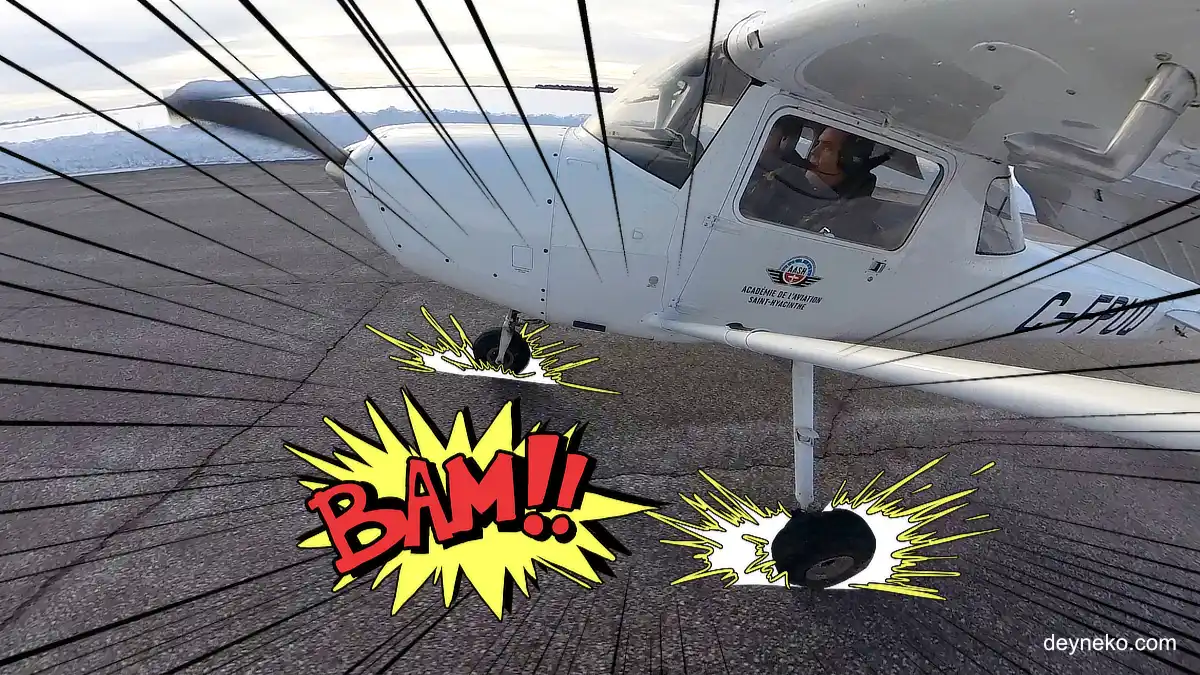
Cessna 152 bounced landing and go-around video from one of my student-pilot training flights at St-Hyacinthe. This is not a go-around tutorial: I mishandled the crosswind on landing, the aircraft bounced, and my instructor immediately called an overshoot. For a more formal instructor-led training video, see my Cessna 152 precautionary landing procedure video.
Video
Video transcript
Subtitles from the flight, lightly cleaned for reading. “Me” = student pilot (radio calls and replies); “Instructor” = my flight instructor, Thomas Villeneuve, coaching from the right seat.
[00:05] Me (radio): “St-Hyacinthe traffic, Foxtrot Papa Uniform Quebec, on final, runway 20, for full stop.”
[00:16] Instructor: “Put your nose in the wind. Your airspeed — I want you to have a nice airspeed. Twenty degrees, yes, 20 degrees of flaps. And I want you to have a lower airspeed.”
[00:34] Instructor: “With the crosswind it’s something… It’s 65 knots.”
[00:49] Instructor: “Then I want you to move your nose a little bit to the left. Okay — left rudder, and start.”
[01:04] Instructor: “Overshoot.” — “Yeah.”
[01:06] Instructor: “Yeah.”
[01:09] Me: “Oh my God!”
[01:10] Instructor: “Yeah.”
[01:12] Instructor: “And… your carburetor heat — carb heat off. Full power. Full power, flaps up step by step. Ten degrees. Perfect. Safe speed — we can bring up the other 10 degrees. Perfect. Okay.”
[01:31] Instructor (debrief): “So that was a little bit because you went to the left of the runway, kind of — and you waited a little bit too much before pulling up on the controls, to do the step over the runway. I want you to really go over and fly just over the runway, wait for it, and then…”
[01:52] Me: “Yeah, I just tried to do it very fast, you know.” Instructor: “No worries, no worries.” Me: “I’m sorry.” Instructor: “No worries. We survived, so it’s okay.”
[02:02] Instructor: “So we can turn crosswind… We can turn downwind here.”
[02:45] Me (radio): “St-Hyacinthe traffic, FPUQ, on downwind, runway zero-two-zero, for full stop.”
[02:58] Instructor: “Then you can do your mid-runway checklist.” Me: “Okay — carb… both… primer locked… altitude… belts. Okay.” Instructor: “Perfect.”
[03:17] Instructor: “You can reduce your airspeed, go back to 100. You can’t descend now on base — stay at the same altitude for now. About 15 degrees of flaps.”
[03:38] Instructor: “We’ll go to base now. And look at your airspeed, be careful.”
[03:50] Instructor: “You can start the descent now. Watch your airspeed — I don’t want you to go too fast. 65 or 70, around that. I think that’s enough.”
[04:04] Me (radio): “Final.”
[04:15] Me (radio): “St-Hyacinthe traffic, FPUQ, on final, runway 20, for full stop.”
[04:23] Instructor: “We’re high right now — pull the power… Right.”
[04:43] Instructor: “Airspeed. Fast.”
[04:58] Instructor: “Pull the power… pull the power… pull the power. Alright.” (touchdown — clean landing)
On the first landing attempt at St-Hyacinthe, I did not handle the crosswind well enough. The Cessna 152 touched down badly and bounced, and my instructor immediately called an overshoot — the term often used in Canada for a go-around.
Climbing away, he briefly explained what had happened: I had drifted left of the runway and waited too long before pulling up over it. I apologized, and he answered with cockpit humor: “No worries. We survived, so it’s okay.”
The useful part is mostly in the first two minutes: the bounced landing, the go-around, and the short cockpit debrief. The rest of the video shows the next circuit and another landing attempt.
What I took from it was simple: keep flying the airplane over the runway instead of rushing the landing, and go around early when a landing is not working.
This page is only a record of a real training moment. For actual procedures, use the aircraft POH, your instructor, and your flight school’s standard procedures.

This page is only a record of a real training moment, not a procedure guide. For the actual go-around procedure, use the aircraft POH, your instructor, and your flight school’s standard procedures. Transport Canada explains why an unstable approach should end in a go-around in its article on stabilized approaches and go-arounds.
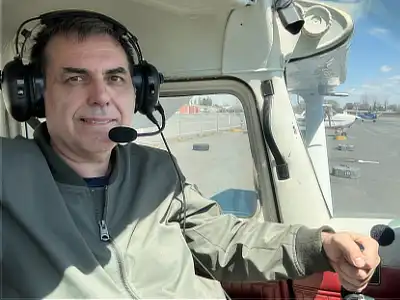
Alexander Deyneko is a student pilot in the final stages of completing his Private Pilot Licence. Member of the Canadian Owners and Pilots Association (COPA). Has flown the Cessna 152 and 172 and the Schleicher ASK-21 glider, with familiarization flights in the historic Boeing Stearman PT-17 and Harvard Mk. IV. A former paragliding pilot-instructor certified by the Russian United Federation of Ultralight Aviation, where he also founded and ran a private paragliding club. Documentary filmmaker covering aviation subjects, with experience in aerial and 360° video production.
More about the author…
Nice video! Do you use GoPro Max?
No. Insta 360