
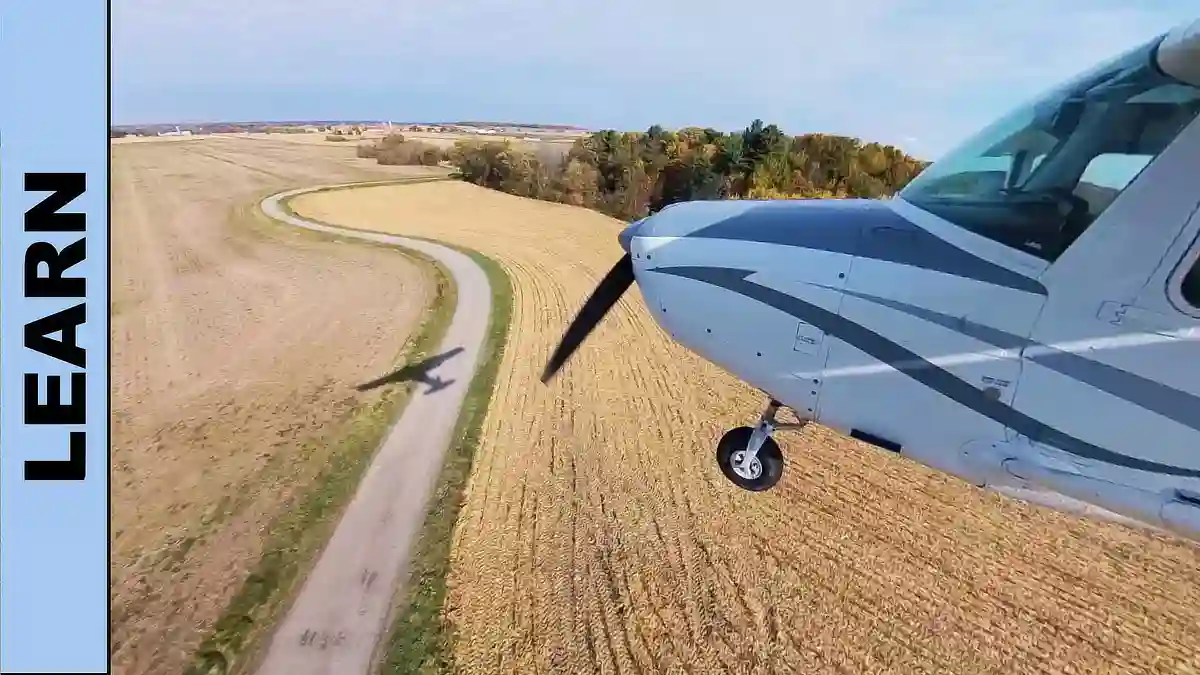
Precautionary landing procedure demonstrated by a Transport Canada-rated flight instructor in a Cessna 152 during PPL training in Quebec.
Transcript video
Format: Dual instructional flight with a Canadian flight instructor, precautionary landing exercise
Aircraft: Cessna C150, circuit altitude 1,200 ft ASL (~1,000 ft AGL)
Language: English (one brief French exchange noted)
Speaker key
[FI] — Instructor
[SP] — Student
(no label) — Unclear / overlapping
Phase 1 — Initial Assessment & Field Selection (0:00–0:32)
[FI]: Wind coming like this.
[SP]: Yeah.
[FI]: So you can choose any direction on the fields, right?
[SP]: Same thing. Yeah.
[FI]: Perfect.
[Brief exchange in French]
[FI]: OK. So my controls.
[SP]: OK.
[FI]: I’ll show you, OK? See that field right there — with the road zigzag?
[SP]: Yeah.
[FI]: Perfect. We’re going to choose that one.
[FI]: Carburetor heat on. Because we’re going to descend here.
Phase 2 — High Pass at 1,000 ft AGL (0:24–1:34)
[FI]: So the precautionary landing — if somebody’s sick, or if nighttime is coming, or the weather is getting bad, right? You want to evaluate the field to see if you can land on it.
[FI]: So 1,200 — because 1,000 AGL. We’re going to look offset on the field a little bit so we can see it. And the first pass is the high pass. We can look for general obstacles. Let’s see if there are any obstacles that could prevent us from landing there.
[FI]: So look at the field. How does it look?
[SP]: It’s nice.
[FI]: It looks OK? This one or that one?
[SP]: The one with the zigzag road at the beginning.
[FI]: The one with the road right at the beginning — the one right under us.
[SP]: OK.
[FI]: The closer one?
[SP]: Yeah, the closer one. It is nice. It looks short. It looks good.
[FI]: Is there any electrical wires or obstacles?
[SP]: No.
[FI]: OK.
[FI]: On our downwind we’re looking also for reference points. Our downwind is going to be over those white buildings over there. Do you see those white buildings in the line?
[SP]: Yeah.
[FI]: That’s our downwind, OK? So tell me when the field ends. Let me know when the field ends.
[SP]: End.
[FI]: End?
[SP]: Yeah.
[FI]: OK.
[FI]: So it looked pretty good, right? There were no ditches, no wires, no houses or machinery or anything, OK?
[SP]: No, nothing.
[FI]: So look — we’re maintaining an altitude. We’ve decided it’s worth it. So we’re turning crosswind.
Phase 3 — Setting Up for the Low Pass (1:45–3:11)
[FI]: Yeah, looks like the field was cut short. It looks pretty good, right? We didn’t see any obstacles. We’re maintaining 1,000 AGL. And we decided that it looks good enough to do a low pass.
[FI]: But now we’re going to turn downwind over these white houses here.
[FI]: OK, and we’re landing in this direction.
[SP]: Yes, I know.
[FI]: Perfect.
[FI]: So we’re maintaining. We’re going to “crab” a little bit for the wind, right? Because the wind is pushing us this way.
[SP]: Yeah.
[FI]: Plane’s nicely trimmed, you see?
[FI]: So now it’s like a normal downwind. What do we do on downwind?
[SP]: Downwind check — pre-landing. Carburetor check.
[FI]: Boom, boom. This is on both. This is good. We can turn that off. Carb heat is on. We have the mixture rich, the fuel tank on, seat belts and doors fastened. The field is there.
[SP]: Yeah.
[FI]: Now we’re going to put 10 degrees of flaps — like normal downwind.
[FI]: So 45 degrees, like usual, right? The field is 45 degrees.
[SP]: Not yet.
[FI]: Yeah, not yet, no. Like that, I think.
[FI]: So for this exercise, it’s a good idea to go further.
[SP]: Why?
[FI]: Because we need to set the plane up properly for the low pass. Biggest mistake I see with students is that they turn too soon — and they don’t have time to set up the plane at 20 degrees of flaps at the right speed. Because the speed we want for the low pass is 70 knots and 20 degrees of flaps.
Phase 4 — Low Pass at 500 ft AGL, Field Timing (3:11–4:58)
[FI]: So now we’re going to pass, so we’re going to reduce the power. Like usual — 1,500 RPM — let the nose drop. And we’re going to put 20 degrees of flaps on base, OK?
[SP]: So 20 degrees.
[FI]: Now we have 70. So we’re going to try to keep 70 this whole time.
[FI]: OK, there’s the field. We’re descending to what altitude?
[SP]: About 500, I think.
[FI]: 500 AGL — which is how much indicated?
[SP]: 500 ft and…
(overlapping): more than 500.
[SP]: Yeah — 600.
[FI]: 700. We’re going to do 700, OK?
[FI]: So we’re going to turn now. We’re still descending. We’re still at 70 knots — do you see?
[FI]: OK, and when we get to the beginning of the field there — where it comes further, closer to us — we’re going to start timing. So I want to keep 70 knots with 20 degrees of flaps. So I’m going to adjust the trim and everything now so that we can keep 70 knots in level flight, OK? And we’re crabbing to the wind. So we’re also going to time our pass over the field. And we’re also going to look more closely for obstacles and surface condition, since we’re lower now. We can see it.
[FI]: So look — 700 ft and 70 knots.
[FI]: So tell me when we start at the field. Where does it start?
[SP]: Not yet.
[FI]: OK, tell me when.
[SP]: Now?
[FI]: No, no, no. Not yet?
[SP]: Not yet.
[FI]: The beginning — where is the beginning?
[SP]: Field started.
[FI]: OK, perfect. So 25 seconds on this watch, OK?
[SP]: 25 seconds…
[FI]: So we’re looking. What do you see? Do you notice any obstacles?
[SP]: No, there aren’t any obstacles.
[FI]: How is the condition of the surface?
[SP]: Nice.
[FI]: It looks good. Looks like we can land on it?
[SP]: Yeah.
[FI]: OK, our speed — look — 70 knots, close, and 700 feet. We’re staying stable, OK?
[FI]: So we’re still looking for obstacles. Tell me when the field ends.
[SP]: Field ends.
[FI]: OK, so 25 seconds.
Phase 5 — Field Length Calculation & Decision (4:58–5:28)
[FI]: How many feet is the field? 25 seconds and 70 knots. 70 knots indicated — which is about 60 knots ground speed. So it’s about 100 feet per second.
(calculating)
[FI]: 100… and 2,000 something.
[SP]: 2,500.
[FI]: 2,500 feet. All right — so never below 2,000 feet. A field below 2,000 is too short. So it’s 2,500 feet.
[FI]: And how does it look?
[SP]: It looks OK.
[FI]: So we have to make a decision. Do we land there?
[SP]: Yeah.
[FI]: Yes, perfect. So overshoot.
Phase 6 — Overshoot & Return to Circuit (5:28–6:40)
[FI]: Full power, carb heat off. Flaps are already 20. So I want to confirm positive rate and good speed. Flaps 10. We’re going to wait. OK — positive rate, good speed. Flaps zero. We’re turning crosswind. So one hand on the power. We’re climbing at Vy. And we’re going to turn crosswind.
[FI]: So we make a decision to go to the field. So back up to the original circuit altitude — which is 1,200 feet.
[SP]: 1,000, yeah.
[FI]: 1,200.
[SP]: 1,000 AGL — plus 200 elevation.
[FI]: There’s our field.
[FI]: OK, we’re back at 1,200 feet. So attitude is for the circle — 1,200 feet ASL. Trimming the plane. We use these houses for downwind.
[SP]: These houses, yeah.
[FI]: Perfect. So we’re turning downwind.
[FI]: Perfect. We have 1,200 feet. And we’re on downwind. A little bit…
[FI]: You want to go this way, with us?
[SP]: Yeah.
[FI]: OK, grab the nose. Good call. Perfect.
[FI]: And on downwind, you can do the cabin check.
[SP]: Cabin check — primer locked, master both…
[FI]: Here. Perfect. Carb heat on.
Phase 7 — Final Approach & Simulated Landing (6:59–8:40)
[FI]: Did you do a precautionary landing?
[SP]: Have I ever done one?
[SP]: No, in real life, no.
[FI]: So 10 degrees flaps — we’re in the white arc. We’re crabbing still, so we don’t get closer. Perfect altitude, OK. 1,200 feet still indicated. But that field is so nice that we can easily land in that field and take off again. Because it’s beautiful. It’s cut short. It’s nice.
[FI]: OK, so when we’re 45 degrees… we’re about now. Reduce power. Let the nose drop. And we’re going to turn base.
[FI]: We’re keeping 70 knots on base. That’s the usual speed. 20 degrees of flaps now. And we’re just going to trim the plane to fly at 70 knots. We’re on base. Level the wings. There’s the field. We’re going to turn final.
[FI]: OK, we want 60 knots on final. Full flaps. There’s our field. 65 knots is OK for now — because we’ll slow it down after.
[FI]: And it’s a good idea on final when you land in a field to open the doors. Just open them a little bit, OK? So we’re trimmed. Look — trim. Nice, nice. This looks good. Speed’s good. Nice.
[FI]: Add the power. And we would land in this field, OK? Without any problem. So now we would straighten the nose. And our speed — look — 60 knots. Perfect. We would land.
Phase 8 — Go-Around & Conclusion (8:37–8:59)
[FI]: OK, so go around. Full power. Carb heat off, flaps 20 right away. We’re going to confirm positive rate of climb here. And airspeed — safe airspeed. Flaps 10.
[FI]: OK — positive rate. Good airspeed. Flaps zero. And we climb Vy, trim for Vy. Climb the whole time, OK?
[FI]: So your controls.
Summary of Key Techniques Covered
| Phase | Altitude | Speed | Flaps | Purpose |
|---|---|---|---|---|
| High pass | 1,000 ft AGL (1,200 ASL) | Cruise | 0° | General obstacle scan, field selection |
| Low pass | 500 ft AGL (~700 ASL) | 70 kts | 20° | Surface condition, obstacle detail, field timing |
| Final approach | Descending | 60–65 kts | Full | Simulated landing assessment |
| Overshoots | — | Vy | 20°→10°→0° | Go-around procedure |
Field length calculation method:
Time over field (seconds) × ground speed in ft/sec
(e.g., 25 sec × ~100 ft/sec ≈ 2,500 ft — minimum acceptable: 2,000 ft)
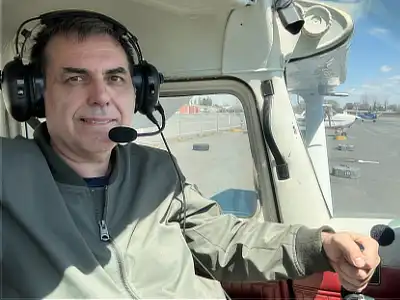
Alexander Deyneko is a student pilot in the final stages of completing his Private Pilot Licence. Member of the Canadian Owners and Pilots Association (COPA). Has flown the Cessna 152 and 172 and the Schleicher ASK-21 glider, with familiarization flights in the historic Boeing Stearman PT-17 and Harvard Mk. IV. A former paragliding pilot-instructor certified by the Russian United Federation of Ultralight Aviation, where he also founded and ran a private paragliding club. Documentary filmmaker covering aviation subjects, with experience in aerial and 360° video production.
More about the author…