

This Cessna 172 preflight inspection differs from the classical and consists two parts.
Video: Preflight check Cessna 172
This instructional video demonstrates the complete pre-flight inspection procedure for a Cessna 172 aircraft. An instructor guides the viewer through the critical safety checks required before takeoff, covering two main phases:
- Fluids Check: Verifying fuel quality and quantity, checking oil levels, and testing fuel system integrity .
- Exterior Walk-Around: A visual inspection of the fuselage, wings, control surfaces, propeller, and landing gear .
Video transcript: Cessna 172 preflight check
Phase 1: Initial Cabin & Release Checks
Instructor: Control lock is removed and put into this pocket here to make sure it’s always in the same place. We look around. Is there any blockage on the flaps? No blockage.
Then after, I can remove everything around and detach the aircraft. So to liberate the aircraft, I make sure that pitot heat cover is removed. The choke, only the first one is removed, because we want to use the back one as a stoppage. Then we detach the aircraft. Lock, unlock. Store the rope here. We don’t want to put it next to the propeller to be absorbed.
Now there is no blockage here. We can remove the back tie-down. We are detaching the back like so. Then we are going to continue the detaching of the aircraft. Chocks here are removed. Aircraft is detached. Bird plugs are removed and stored in the baggage compartment. The pitot cover goes in the back of your seat. Just make sure that the aircraft is free.
Phase 2: Fluids Check (Fuel & Oil)
Instructor: Now I’m going to check the liquids. I’m going to verify the quality of the fuel. Blue color indicates 100 LL. There is no sediment, no sand, no rust, no air bubbles, no water bubbles, liquid is transparent.
I will check on the lowest point of the aircraft too. Check again. Color is good. And the left-hand side. We are going to check the wing too on this side. Again, look, color is good. No sediments, no water. So quality of the fuel is good for today.
Oil Check: Now I can check the oil. Open the trap and unlatch the oil cover. First clean it. Then I look at the levels. Be careful of the wind. I’m looking now—it’s five and a half. Minimum four, maximum six. Five and a half is perfect. So I clean it and put it back here. Make sure that it’s in. Do not turn it hard, just a little bit to close it; vibration will tighten it.
Fuel System Integrity: Now I’m going to check the integrity of the fuel system. There is a little white lever here. You have to pull it up. You will see that fuel flows, which means the aircraft fuel system is okay. Now I’m going to close the fuel selector, put it on “OFF” and do the same test. Usually, the fuel flow must stop. [engine humming sound]. It stopped. So now integrity of the fuel system is checked.
Fuel Quantity: Now we are going to check fuel quantity using the dipstick. The goal is to put it at the back of the tank, create a vacuum, pull it up and do the readout.
- Left Tank: I do three readings: 15, 16, and 15. I take the worst of the three. So, 15 gallons.
- Right Tank: Here we have 12, 12, 13. So 12.
- Total: 27 gallons, which is plenty for us.
Calculation: For minimum VFR flying, you must have the fuel for the duration of your flight plus a 30-minute security reserve.
Everything is good in terms of fluid. Now we are going to do the walk-around.
Phase 3: Exterior Walk-Around
Preparation: First, before activating anything, I look a last time that there is no blockage around the flaps. Then I’m going to activate the master battery. Master battery ON, beacon light is ON (checking it is flashing). I will set 20 degrees of flaps. Then battery is OFF to save power.
Left Wing & Fuselage:
- Flaps: Checking screws, maintenance strap (three screws), ensure it is not locked. Not bent.
- Aileron: Check four screws inside, metal balance, and movement. I can see the yoke moving properly inside.
- Wing Leading Edge: Light is good. Leading edge should not be contaminated by insects, dirt, or ice. Stall warning is great. Pitot tube has no blockage.
- Left Landing Gear: Check hydraulic fluid (no leakage). Brakes are moving properly inside. Tire seems inflated, no flat spots. Check the pin and screws.
Nose & Engine Section:
- Cowling & Static: Static port is okay, no blockage. Screws on the cowling are all in place.
- Nose Gear: Check the pin, no hydraulic leakage (reddish/pink color), strut pressure is good. No flat spots on the tire.
- Intakes: Inside air intakes: no birds’ nests, plants, or blockage.
- Propeller: No bends, no dents. Alternator belt is good and attached. Landing light not broken. Air filter is clean.
- Exhaust: Still attached. If you hear a clunk or something moving, it’s not good.
- Shimmy Damper: No leakage, still there.
Right Wing & Fuselage:
- Right Landing Gear: Pins, brakes, hydraulic lines checked. Tire inflation good, no flat spots.
- Wing Leading Edge: Clean. Lights are good.
- Aileron & Flaps: Check screws, counterweight, movement. Flaps secure.
- Top of Wing: Upper side seems great. Fuel caps are secured.
Antennas & Empennage (Tail):
- Antennas: VHF antennas good. GPS attached. ADF and ELT antennas present.
- Fuselage side: Traps secure, no missing screws.
- Tail Control Surfaces: Checking movement of controls—free and correct. Trim tab attached. Rudder and elevator cables are good.
- Stops: Stop screws for elevator and rudder are present. If these are bent, it alters aerodynamic properties.
- Rear Lighting & Antennas: VOR antenna in good shape. Beacon light working.
Final Walk: Leading edge of the tail is clean. Closing antennas not destroyed. Final look from the front: Aircraft is level. Chocks attached properly. No bird plugs. Globally, the aircraft is great. This concludes the pre-flight.
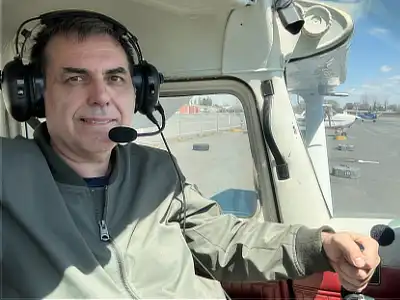
Alexander Deyneko is a student pilot in the final stages of completing his Private Pilot Licence. Member of the Canadian Owners and Pilots Association (COPA). Has flown the Cessna 152 and 172 and the Schleicher ASK-21 glider, with familiarization flights in the historic Boeing Stearman PT-17 and Harvard Mk. IV. A former paragliding pilot-instructor certified by the Russian United Federation of Ultralight Aviation, where he also founded and ran a private paragliding club. Documentary filmmaker covering aviation subjects, with experience in aerial and 360° video production.
More about the author…